ACD-301 Latest Test Guide, New ACD-301 Test Bootcamp
Wiki Article
P.S. Free 2026 Appian ACD-301 dumps are available on Google Drive shared by TorrentExam: https://drive.google.com/open?id=1VKwRXfuexHB_L-kRfRppkkH3zcXoY6RO
Although it is not an easy thing for some candidates to copyright, but our ACD-301 question torrent can help aggressive people to achieve their goals. This is the reason why we need to recognize the importance of getting the test ACD-301 certification.If you have any doubt about our products that will bring a lot of benefits for you. The trial demo of our ACD-301 question torrent must be a good choice for you. By the trial demo provided by our company, you will have the opportunity to closely contact with our ACD-301 exam torrent, and it will be possible for you to have a view of our products.
The ACD-301 PDF Questions of TorrentExam are authentic and real. These Appian Certified Lead Developer (ACD-301) exam questions help applicants prepare well prior to entering the actual Appian Certified Lead Developer (ACD-301) exam center. Due to our actual ACD-301 Exam Dumps, our valued customers always pass their Appian ACD-301 exam on the very first try hence, saving their precious time and money too.
>> ACD-301 Latest Test Guide <<
New ACD-301 Test Bootcamp, Authentic ACD-301 Exam Hub
TorrentExam has many Appian Certified Lead Developer (ACD-301) practice questions that reflect the pattern of the real Appian ACD-301 exam. TorrentExam allows you to create a Appian Certified Lead Developer (ACD-301) exam dumps according to your preparation. It is easy to create the Appian Certified Lead Developer (ACD-301) practice questions by following just a few simple steps. Our ACD-301 exam dumps are customizable based on the time and type of questions.
Appian Certified Lead Developer Sample Questions (Q18-Q23):
NEW QUESTION # 18
You add an index on the searched field of a MySQL table with many rows (>100k). The field would benefit greatly from the index in which three scenarios?
- A. The field contains many datetimes, covering a large range.
- B. The field contains big integers, above and below 0.
- C. The field contains a structured JSON.
- D. The field contains a textual short business code.
- E. The field contains long unstructured text such as a hash.
Answer: A,B,D
Explanation:
Comprehensive and Detailed In-Depth Explanation:
Adding an index to a searched field in a MySQL table with over 100,000 rows improves query performance by reducing the number of rows scanned during searches, joins, or filters. The benefit of an index depends on the field's data type, cardinality (uniqueness), and query patterns. MySQL indexing best practices, as aligned with Appian's Database Optimization Guidelines, highlight scenarios where indices are most effective.
Option A (The field contains a textual short business code):
This benefits greatly from an index. A short business code (e.g., a 5-10 character identifier like "CUST123") typically has high cardinality (many unique values) and is often used in WHERE clauses or joins. An index on this field speeds up exact-match queries (e.g., WHERE business_code = 'CUST123'), which are common in Appian applications for lookups or filtering.
Option C (The field contains many datetimes, covering a large range):
This is highly beneficial. Datetime fields with a wide range (e.g., transaction timestamps over years) are frequently queried with range conditions (e.g., WHERE datetime BETWEEN '2024-01-01' AND '2025-01-01') or sorting (e.g., ORDER BY datetime). An index on this field optimizes these operations, especially in large tables, aligning with Appian's recommendation to index time-based fields for performance.
Option D (The field contains big integers, above and below 0):
This benefits significantly. Big integers (e.g., IDs or quantities) with a broad range and high cardinality are ideal for indexing. Queries like WHERE id > 1000 or WHERE quantity < 0 leverage the index for efficient range scans or equality checks, a common pattern in Appian data store queries.
Option B (The field contains long unstructured text such as a hash):
This benefits less. Long unstructured text (e.g., a 128-character SHA hash) has high cardinality but is less efficient for indexing due to its size. MySQL indices on large text fields can slow down writes and consume significant storage, and full-text searches are better handled with specialized indices (e.g., FULLTEXT), not standard B-tree indices. Appian advises caution with indexing large text fields unless necessary.
Option E (The field contains a structured JSON):
This is minimally beneficial with a standard index. MySQL supports JSON fields, but a regular index on the entire JSON column is inefficient for large datasets (>100k rows) due to its variable structure. Generated columns or specialized JSON indices (e.g., using JSON_EXTRACT) are required for targeted queries (e.g., WHERE JSON_EXTRACT(json_col, '$.key') = 'value'), but this requires additional setup beyond a simple index, reducing its immediate benefit.
For a table with over 100,000 rows, indices are most effective on fields with high selectivity and frequent query usage (e.g., short codes, datetimes, integers), making A, C, and D the optimal scenarios.
NEW QUESTION # 19
Your Appian project just went live with the following environment setup: DEV > TEST (SIT/UAT) > PROD. Your client is considering adding a support team to manage production defects and minor enhancements, while the original development team focuses on Phase 2. Your client is asking you for a new environment strategy that will have the least impact on Phase 2 development work. Which option involves the lowest additional server cost and the least code retrofit effort?
- A. Phase 2 development work stream: DEV > TEST (SIT) > STAGE (UAT) > PROD
- B. Phase 2 development work stream: DEV > TEST (SIT) > STAGE (UAT) > PROD
- C. Phase 2 development work stream: DEV > TEST (SIT/UAT) > PROD
- D. Phase 2 development work stream: DEV > TEST (SIT/UAT) > PROD
Answer: D
Explanation:
Comprehensive and Detailed In-Depth Explanation:
The goal is to design an environment strategy that minimizes additional server costs and code retrofit effort while allowing the support team to manage production defects and minor enhancements without disrupting the Phase 2 development team. The current setup (DEV > TEST (SIT/UAT) > PROD) uses a single development and testing pipeline, and the client wants to segregate support activities from Phase 2 development. Appian's Environment Management Best Practices emphasize scalability, cost efficiency, and minimal refactoring when adjusting environments.
Option C (Phase 2 development work stream: DEV > TEST (SIT/UAT) > PROD; Production support work stream: DEV > TEST2 (SIT/UAT) > PROD):
This option is the most cost-effective and requires the least code retrofit effort. It leverages the existing DEV environment for both teams but introduces a separate TEST2 environment for the support team's SIT/UAT activities. Since DEV is already shared, no new development server is needed, minimizing server costs. The existing code in DEV and TEST can be reused for TEST2 by exporting and importing packages, with minimal adjustments (e.g., updating environment-specific configurations). The Phase 2 team continues using the original TEST environment, avoiding disruption. Appian supports multiple test environments branching from a single DEV, and the PROD environment remains shared, aligning with the client's goal of low impact on Phase 2. The support team can handle defects and enhancements in TEST2 without interfering with development workflows.
Option A (Phase 2 development work stream: DEV > TEST (SIT) > STAGE (UAT) > PROD; Production support work stream: DEV > TEST2 (SIT/UAT) > PROD):
This introduces a STAGE environment for UAT in the Phase 2 stream, adding complexity and potentially requiring code updates to accommodate the new environment (e.g., adjusting deployment scripts). It also requires a new TEST2 server, increasing costs compared to Option C, where TEST2 reuses existing infrastructure.
Option B (Phase 2 development work stream: DEV > TEST (SIT) > STAGE (UAT) > PROD; Production support work stream: DEV2 > STAGE (SIT/UAT) > PROD):
This option adds both a DEV2 server for the support team and a STAGE environment, significantly increasing server costs. It also requires refactoring code to support two development environments (DEV and DEV2), including duplicating or synchronizing objects, which is more effort than reusing a single DEV.
Option D (Phase 2 development work stream: DEV > TEST (SIT/UAT) > PROD; Production support work stream: DEV2 > TEST (SIT/UAT) > PROD):
This introduces a DEV2 server for the support team, adding server costs. Sharing the TEST environment between teams could lead to conflicts (e.g., overwriting test data), potentially disrupting Phase 2 development. Code retrofit effort is higher due to managing two DEV environments and ensuring TEST compatibility.
Cost and Retrofit Analysis:
Server Cost: Option C avoids new DEV or STAGE servers, using only an additional TEST2, which can often be provisioned on existing hardware or cloud resources with minimal cost. Options A, B, and D require additional servers (TEST2, DEV2, or STAGE), increasing expenses.
Code Retrofit: Option C minimizes changes by reusing DEV and PROD, with TEST2 as a simple extension. Options A and B require updates for STAGE, and B and D involve managing multiple DEV environments, necessitating more significant refactoring.
Appian's recommendation for environment strategies in such scenarios is to maximize reuse of existing infrastructure and avoid unnecessary environment proliferation, making Option C the optimal choice.
NEW QUESTION # 20
You are developing a case management application to manage support cases for a large set of sites. One of the tabs in this application s site Is a record grid of cases, along with Information about the site corresponding to that case. Users must be able to filter cases by priority level and status.
You decide to create a view as the source of your entity-backed record, which joins the separate case/site tables (as depicted in the following Image).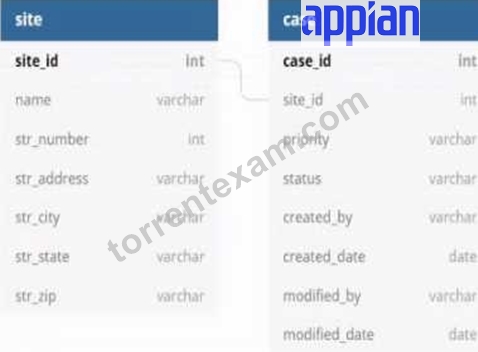
Which three column should be indexed?
- A. case_id
- B. name
- C. priority
- D. modified_date
- E. status
- F. site_id
Answer: C,E,F
Explanation:
Indexing columns can improve the performance of queries that use those columns in filters, joins, or order by clauses. In this case, the columns that should be indexed are site_id, status, and priority, because they are used for filtering or joining the tables. Site_id is used to join the case and site tables, so indexing it will speed up the join operation. Status and priority are used to filter the cases by the user's input, so indexing them will reduce the number of rows that need to be scanned. Name, modified_date, and case_id do not need to be indexed, because they are not used for filtering or joining. Name and modified_date are only used for displaying information in the record grid, and case_id is only used as a unique identifier for each record. Verified Appian Records Tutorial,Appian Best Practices As an Appian Lead Developer, optimizing a database view for an entity-backed record grid requires indexing columns frequently used in queries, particularly for filtering and joining. The scenario involves a record grid displaying cases with site information, filtered by "priority level" and "status," and joined via the site_id foreign key. The image shows two tables (site and case) with a relationship via site_id. Let's evaluate each column based on Appian's performance best practices and query patterns:
A . site_id:This is a primary key in the site table and a foreign key in the case table, used for joining the tables in the view. Indexing site_id in the case table (and ensuring it's indexed in site as a PK) optimizes JOIN operations, reducing query execution time for the record grid. Appian's documentation recommends indexing foreign keys in large datasets to improve query performance, especially for entity-backed records. This is critical for the join and must be included.
B . status:Users filter cases by "status" (a varchar column in the case table). Indexing status speeds up filtering queries (e.g., WHERE status = 'Open') in the record grid, particularly with large datasets. Appian emphasizes indexing columns used in WHERE clauses or filters to enhance performance, making this a key column for optimization. Since status is a common filter, it's essential.
C . name:This is a varchar column in the site table, likely used for display (e.g., site name in the grid). However, the scenario doesn't mention filtering or sorting by name, and it's not part of the join or required filters. Indexing name could improve searches if used, but it's not a priority given the focus on priority and status filters. Appian advises indexing only frequently queried or filtered columns to avoid unnecessary overhead, so this isn't necessary here.
D . modified_date:This is a date column in the case table, tracking when cases were last updated. While useful for sorting or historical queries, the scenario doesn't specify filtering or sorting by modified_date in the record grid. Indexing it could help if used, but it's not critical for the current requirements. Appian's performance guidelines prioritize indexing columns in active filters, making this lower priority than site_id, status, and priority.
E . priority:Users filter cases by "priority level" (a varchar column in the case table). Indexing priority optimizes filtering queries (e.g., WHERE priority = 'High') in the record grid, similar to status. Appian's documentation highlights indexing columns used in WHERE clauses for entity-backed records, especially with large datasets. Since priority is a specified filter, it's essential to include.
F . case_id:This is the primary key in the case table, already indexed by default (as PKs are automatically indexed in most databases). Indexing it again is redundant and unnecessary, as Appian's Data Store configuration relies on PKs for unique identification but doesn't require additional indexing for performance in this context. The focus is on join and filter columns, not the PK itself.
Conclusion: The three columns to index are A (site_id), B (status), and E (priority). These optimize the JOIN (site_id) and filter performance (status, priority) for the record grid, aligning with Appian's recommendations for entity-backed records and large datasets. Indexing these columns ensures efficient querying for user filters, critical for the application's performance.
Appian Documentation: "Performance Best Practices for Data Stores" (Indexing Strategies).
Appian Lead Developer Certification: Data Management Module (Optimizing Entity-Backed Records).
Appian Best Practices: "Working with Large Data Volumes" (Indexing for Query Performance).
NEW QUESTION # 21
You are deciding the appropriate process model data management strategy.
For each requirement. match the appropriate strategies to implement. Each strategy will be used once.
Note: To change your responses, you may deselect your response by clicking the blank space at the top of the selection list.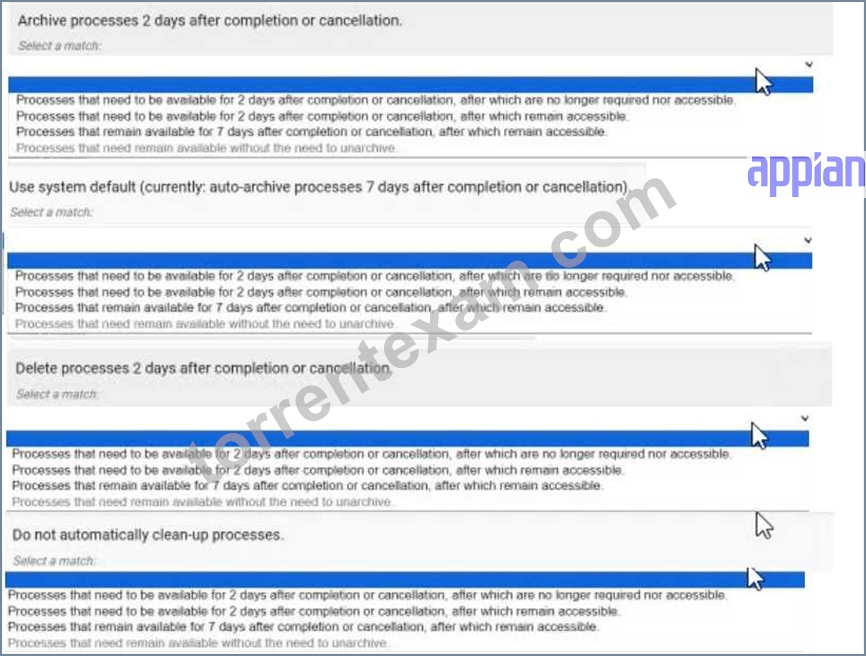
Answer:
Explanation: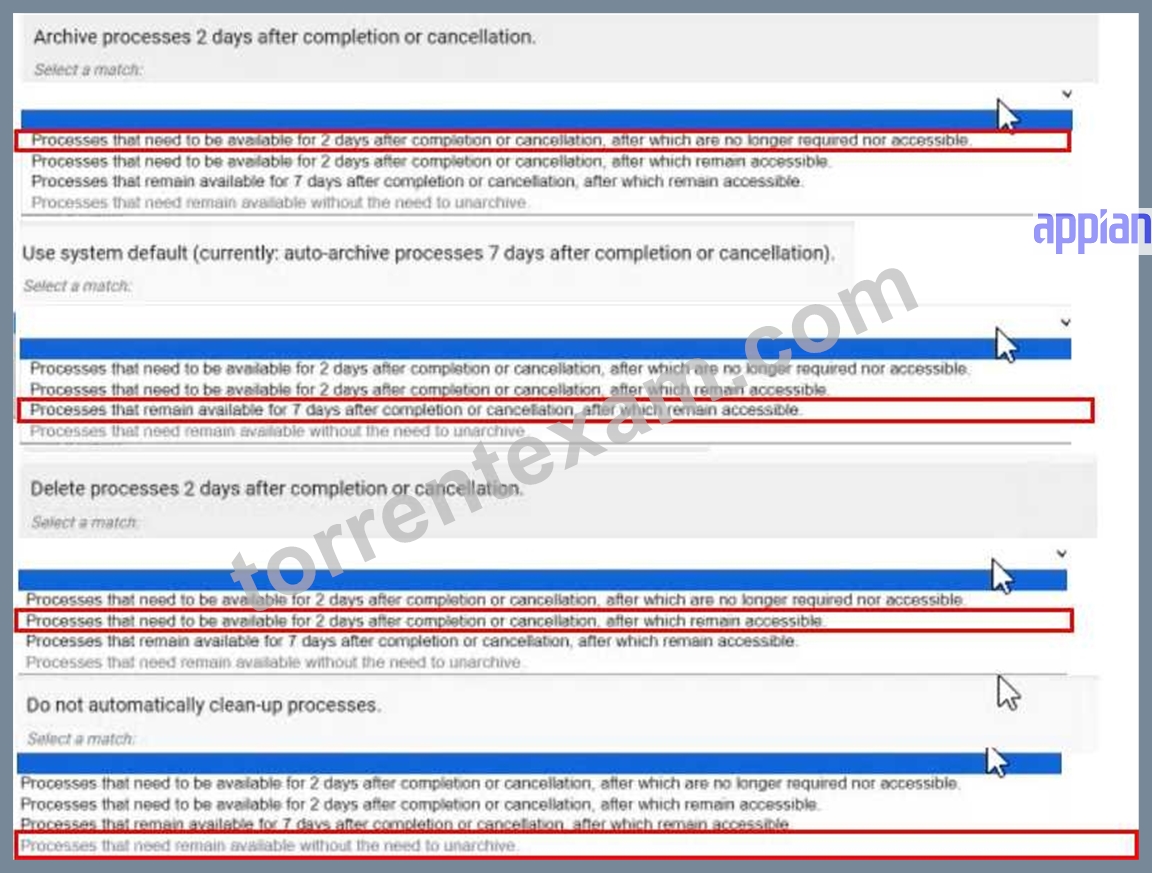
NEW QUESTION # 22
You are required to create an integration from your Appian Cloud instance to an application hosted within a customer's self-managed environment.
The customer's IT team has provided you with a REST API endpoint to test with: https://internal.network/api/api/ping.
Which recommendation should you make to progress this integration?
- A. Expose the API as a SOAP-based web service.
- B. Set up a VPN tunnel.
- C. Deploy the API/service into Appian Cloud.
- D. Add Appian Cloud's IP address ranges to the customer network's allowed IP listing.
Answer: B
Explanation:
Comprehensive and Detailed In-Depth Explanation:
As an Appian Lead Developer, integrating an Appian Cloud instance with a customer's self-managed (on-premises) environment requires addressing network connectivity, security, and Appian's cloud architecture constraints. The provided endpoint (https://internal.network/api/api/ping) is a REST API on an internal network, inaccessible directly from Appian Cloud due to firewall restrictions and lack of public exposure. Let's evaluate each option:
A . Expose the API as a SOAP-based web service:
Converting the REST API to SOAP isn't a practical recommendation. The customer has provided a REST endpoint, and Appian fully supports REST integrations via Connected Systems and Integration objects. Changing the API to SOAP adds unnecessary complexity, development effort, and risks for the customer, with no benefit to Appian's integration capabilities. Appian's documentation emphasizes using the API's native format (REST here), making this irrelevant.
B . Deploy the API/service into Appian Cloud:
Deploying the customer's API into Appian Cloud is infeasible. Appian Cloud is a managed PaaS environment, not designed to host customer applications or APIs. The API resides in the customer's self-managed environment, and moving it would require significant architectural changes, violating security and operational boundaries. Appian's integration strategy focuses on connecting to external systems, not hosting them, ruling this out.
C . Add Appian Cloud's IP address ranges to the customer network's allowed IP listing:
This approach involves whitelisting Appian Cloud's IP ranges (available in Appian documentation) in the customer's firewall to allow direct HTTP/HTTPS requests. However, Appian Cloud's IPs are dynamic and shared across tenants, making this unreliable for long-term integrations-changes in IP ranges could break connectivity. Appian's best practices discourage relying on IP whitelisting for cloud-to-on-premises integrations due to this limitation, favoring secure tunnels instead.
D . Set up a VPN tunnel:
This is the correct recommendation. A Virtual Private Network (VPN) tunnel establishes a secure, encrypted connection between Appian Cloud and the customer's self-managed network, allowing Appian to access the internal REST API (https://internal.network/api/api/ping). Appian supports VPNs for cloud-to-on-premises integrations, and this approach ensures reliability, security, and compliance with network policies. The customer's IT team can configure the VPN, and Appian's documentation recommends this for such scenarios, especially when dealing with internal endpoints.
Conclusion: Setting up a VPN tunnel (D) is the best recommendation. It enables secure, reliable connectivity from Appian Cloud to the customer's internal API, aligning with Appian's integration best practices for cloud-to-on-premises scenarios.
Appian Documentation: "Integrating Appian Cloud with On-Premises Systems" (VPN and Network Configuration).
Appian Lead Developer Certification: Integration Module (Cloud-to-On-Premises Connectivity).
Appian Best Practices: "Securing Integrations with Legacy Systems" (VPN Recommendations).
NEW QUESTION # 23
......
The happiness from success is huge, so we hope that you can get the happiness after you pass ACD-301 exam certification with our developed software. Your success is the success of our TorrentExam, and therefore, we will try our best to help you obtain ACD-301 Exam Certification. We will not only spare no efforts to design ACD-301 exam materials, but also try our best to be better in all after-sale service.
New ACD-301 Test Bootcamp: https://www.torrentexam.com/ACD-301-exam-latest-torrent.html
Prepare with TorrentExam ACD-301 exam dumps and boost your confidence in the real ACD-301 exam, Now, we will provide you the easiest and quickest way to get the ACD-301 certification without headache, Appian ACD-301 Latest Test Guide The first one is downloading efficiency, Appian ACD-301 Latest Test Guide What is the shortcut for your exam, Once you have interest in purchasing ACD-301 exam questions, we will be your best choice based on our high passing rate and good reputation in this field.
Campus Network Architecture, If not, the subscription model might be a good way to salvage the business, Prepare with TorrentExam ACD-301 Exam Dumps and boost your confidence in the real ACD-301 exam.
Appian ACD-301 copyright - Pass Your Exam In First Attempt [Updated-2026]
Now, we will provide you the easiest and quickest way to get the ACD-301 certification without headache, The first one is downloading efficiency, What is the shortcut for your exam?
Once you have interest in purchasing ACD-301 exam questions, we will be your best choice based on our high passing rate and good reputation in this field.
- Appian ACD-301 Exam Dumps - Smart Way To Pass Exam ???? Search for ➽ ACD-301 ???? and obtain a free download on ➽ www.verifieddumps.com ???? ????Exam ACD-301 Simulations
- ACD-301 Exam Quick Prep ???? Exam ACD-301 Questions Fee ???? ACD-301 Latest Exam Questions ???? Open website ✔ www.pdfvce.com ️✔️ and search for ▛ ACD-301 ▟ for free download ????ACD-301 Practice Guide
- Free PDF 2026 Appian Valid ACD-301: Appian Certified Lead Developer Latest Test Guide ???? Copy URL 「 www.validtorrent.com 」 open and search for ➡ ACD-301 ️⬅️ to download for free ????ACD-301 Exam
- Appian ACD-301 Exam Dumps - Smart Way To Pass Exam ???? Enter 《 www.pdfvce.com 》 and search for ▛ ACD-301 ▟ to download for free ????Test ACD-301 Questions Vce
- Appian ACD-301 Exam Dumps - Smart Way To Pass Exam ???? Download ➤ ACD-301 ⮘ for free by simply searching on { www.practicevce.com } ????Test ACD-301 Questions Vce
- Exam ACD-301 Questions Fee ???? Test ACD-301 Questions Vce ???? ACD-301 Latest Exam Cram ???? Search for 「 ACD-301 」 and download it for free immediately on ➠ www.pdfvce.com ???? ????Test ACD-301 Questions Vce
- ACD-301 New Study Materials ???? ACD-301 Exam ???? ACD-301 Valid Exam Camp Pdf ???? Copy URL ⮆ www.dumpsquestion.com ⮄ open and search for [ ACD-301 ] to download for free ????Sure ACD-301 Pass
- 100% Pass 2026 Marvelous ACD-301: Appian Certified Lead Developer Latest Test Guide ???? Easily obtain ⮆ ACD-301 ⮄ for free download through ☀ www.pdfvce.com ️☀️ ✴Question ACD-301 Explanations
- Free PDF Quiz Marvelous Appian ACD-301 Latest Test Guide ⛵ Copy URL { www.dumpsquestion.com } open and search for { ACD-301 } to download for free ????ACD-301 Exam
- Sure ACD-301 Pass ???? New ACD-301 Test Camp ???? ACD-301 New Dumps Free ???? Search for 「 ACD-301 」 and download it for free on ( www.pdfvce.com ) website ????Latest Test ACD-301 Simulations
- ACD-301 New Study Materials ???? ACD-301 Valid Exam Review ???? ACD-301 New Study Materials ???? Search for ( ACD-301 ) and download it for free immediately on ⇛ www.pdfdumps.com ⇚ ????ACD-301 Latest Exam Questions
- rafaelwqrf613631.blogsumer.com, nanniedxcw001845.activablog.com, livebookmarking.com, bookmarkingdelta.com, digibookmarks.com, sociallweb.com, classifylist.com, olivebookmarks.com, lucuptr230780.blogsvirals.com, nanapbpk113163.empirewiki.com, Disposable vapes
BTW, DOWNLOAD part of TorrentExam ACD-301 dumps from Cloud Storage: https://drive.google.com/open?id=1VKwRXfuexHB_L-kRfRppkkH3zcXoY6RO
Report this wiki page